Laudate
- 4.7
- Rating
- 1.00M
- Installs
- Free
- Price

 Analysis by App-foxy
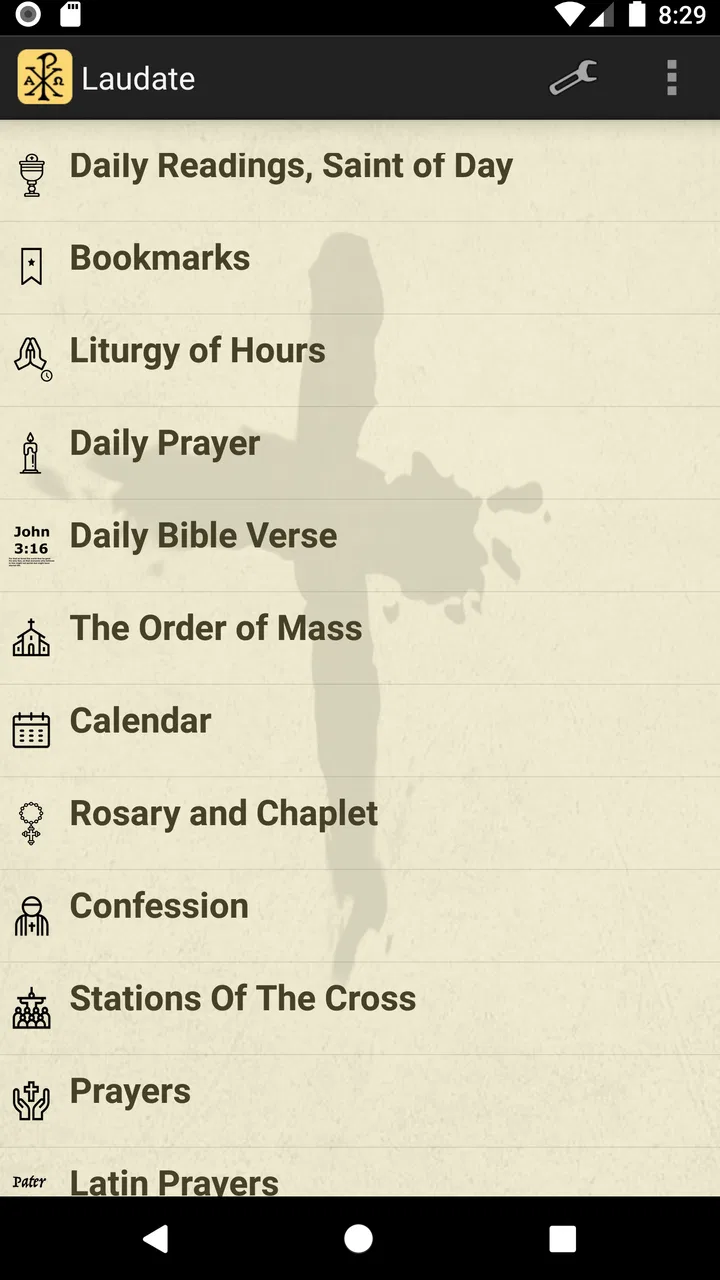
I approached Laudate as the kind of app you open in a quiet moment rather than browse for entertainment. It belongs to Books & Reference, but that label only partly explains its value: the app brings together Catholic readings, prayers, rosaries, and podcasts in one mobile space. In my experience, its biggest strength is not any single section. It is the way those sections can support different routines without making me switch between several unrelated apps.
Aycka Soft has kept the focus firmly on Catholic reference and devotional material. The result feels more like a compact spiritual library than a social platform or a general reading tool. It is free, rated for Everyone, and available for devices running Android 6.0 or later. That combination makes it approachable for families, older phones, and people who simply want to explore without committing money first.
How Laudate fits into everyday Catholic routines
The first thing I noticed is that the app works best when I give it a specific purpose. Opening it with the vague intention of “looking around” can lead to a lot of browsing, because readings, prayers, rosaries, and podcasts each invite a different kind of attention. When I open it before the day starts, I tend to treat it as a reading companion. When I use it later, the prayer and rosary sections become more practical than the longer reference material.
You May Also Like

 Blood Strike: 2.5 Anniversary
Blood Strike’s Loadouts Turn Every Drop Into a Tactical Gamble
A close look at Blood Strike’s custom loadouts: how fast access to signature weapons reshapes its battle royale rhythm, rewards preparation, and narrows the gap between fights.

 Pandora - Music & Podcasts
Pandora’s Music Is Easy to Start, but Harder to Recover
Pandora’s strength is its low-effort path from a seed to a station. Its weak spot is how much confidence it asks you to place in connection, setup, and quiet recovery.

 8 Ball Pool
 Is Built on Rivalries, Rematches, and Routine
A close look at the rivalries, rematches, shared routines, and unanswered safety questions that turn a quick pool match into a persistent mobile community.

 Samsung Music
’s Quiet Strength Is Playing What You Already Own
Its reach comes less from spectacle than from dependable access to a personal library. That simplicity is both the app’s strongest retention engine and its ceiling.

 AccuWeather: Weather Radar
AccuWeather Review: A Quick, Clear Forecast for Everyday Decisions
For everyday plans, the best forecast is the one you can understand quickly. AccuWeather makes rain timing, radar, and local conditions easy to act on, with a few trade-offs.

 Hill Climb Racing
Why Hill Climb Racing Still Turns Crashes Into One More Run
A tiny car, a bumpy hill and one more upgrade: Hill Climb Racing keeps resurfacing because its simple chaos makes every near-miss feel personal.
More From Our News Desk



The daily readings are particularly useful for someone who wants a regular starting point. Instead of searching the wider internet each morning, I can go directly to the app and keep the habit contained in one place. That matters on a phone, where a browser search can quickly turn into notifications, unrelated results, or several open tabs. Laudate gives the routine a clear destination.
Its broader collection also helps when a user is not following a fixed schedule. I can move from a reading to a prayer, or from a prayer to a rosary, without treating each activity as a separate task. This makes the app suitable for a short pause during the day, but it also means that newcomers may need a little time to understand which area deserves their attention.
The most useful approach is to choose the section before opening the app. If I already know that I want a reading, a rosary, or a podcast, I spend less time navigating and more time using the material. That small habit makes the experience feel calmer and avoids turning a reflective moment into ordinary phone browsing.
What happens when the connection is part of the experience
Connectivity matters most around the audio side of Laudate. Podcasts naturally depend on a reliable connection at the moment I want to access them, and that changes how I plan to use that section. At home or on a dependable network, the audio material can fit comfortably into a morning routine or a quiet evening. On a weak mobile signal, however, I would not begin a listening session at the last possible moment.
This is an important distinction between the parts of the app. Reading and prayer are naturally suited to short, focused visits, while podcasts ask for more patience from the network and from the user. If I am leaving home, entering a building with poor reception, or traveling through an area where service changes frequently, I treat the audio section as something to check ahead of time rather than something to rely on spontaneously.
I also found that connectivity changes the emotional quality of the experience. A delayed page or interrupted audio session is not merely inconvenient when the purpose of the app is quiet concentration. It can break the moment completely. For that reason, I prefer to open the app when I have a stable connection and enough time to let the selected material load properly.
Laudate is therefore not equally comfortable in every network situation. It is a better fit for a user who can plan around connectivity than for someone who expects every part of a reference app to behave identically in a tunnel, on a flight, or in a remote location. I would not make assumptions about offline availability; instead, I would test the particular reading, prayer, or podcast I intend to use before depending on it away from a network.
Using it on a small screen, during travel, and at home
On a phone, the app’s collection is both its advantage and its challenge. Having many Catholic resources together saves space and reduces app switching, but a small display makes long reading sessions less comfortable than reading a physical book or a larger tablet screen. I prefer short visits on my phone and longer reading when I am seated somewhere without distractions.
A realistic everyday scenario would be a user who checks the daily reading after breakfast, returns to a prayer during a lunch break, and listens to a podcast at home later in the day. Each visit has a different length and a different network expectation. The app can support that pattern well because it does not force every interaction into the same format.
Travel is where I would be more cautious. A phone is convenient in a hotel room, waiting area, or quiet corner of a parish building, but mobile data may be inconsistent and battery life may already be under pressure. I would open the material I expect to need while connected and avoid treating the app as my only preparation for a journey. A printed prayer book or another already-available resource is still more predictable when reception is uncertain.
The Everyone age rating also makes the app easier to consider in a shared household. That does not mean every family member will find the navigation equally obvious. Someone who is comfortable with Catholic terminology may move through it naturally, while a newcomer may need guidance about where to begin. I would recommend introducing one section at a time instead of presenting the whole collection as a single large menu.
Recovering from interruptions and unfinished sessions
Phone use rarely happens in perfect conditions. A call arrives, another app takes focus, the screen locks, or the connection changes while I am reading or listening. Laudate is most comfortable when I treat each visit as a self-contained session. I try not to assume that an interrupted podcast or reading will always return to exactly the same point without checking.
That habit sounds minor, but it prevents frustration. Before starting a longer piece of audio, I make sure the connection is steady and that I am not about to move into an area with unreliable service. For readings and prayers, I pause at a natural stopping point rather than leaving the app open indefinitely. This makes it easier to return without having to reconstruct what I was doing.
If a page does not load as expected, my first response is simple: check the connection, wait briefly, and try the section again instead of repeatedly tapping through the interface. On a phone, repeated taps can make it difficult to tell whether the app is responding slowly or whether I have opened several actions at once. A calm retry is usually a better workflow than treating every delay as an app failure.
I also recommend keeping a personal routine outside the app. If a particular prayer or reading is important for a scheduled moment, I note its name or place in my daily plan. That way, a temporary network problem does not erase the intention behind the session. Laudate can be the convenient access point, but a dependable habit should not rely entirely on one screen behaving perfectly.
Being thoughtful about mobile data
The most data-conscious way to use Laudate is to separate reading from audio. Text-based sections are naturally easier to fit into a limited mobile plan, while podcasts deserve more deliberate planning. I would use a trusted Wi-Fi connection for audio whenever possible and reserve mobile data for short checks when I know the signal is stable.
This is also a reason to avoid opening several podcast items just to sample them while away from Wi-Fi. Decide what you want to hear first, then start one session. That approach reduces unnecessary loading and makes the app feel less demanding. It is especially sensible for users sharing a family data allowance or using a phone with a strict monthly limit.
Connectivity awareness also helps with battery use. Searching, waiting for content, and retrying a weak connection can consume more time and power than a short reading session. I would not leave the app working in the background while traveling, and I would close the session when I am finished rather than keeping it open as a passive companion.
These are practical habits rather than complaints about the app. Laudate gathers several kinds of content, and each kind behaves differently on a mobile device. A reader who understands that difference will have a smoother experience than someone expecting the audio, prayer, and reading areas to place identical demands on the phone.
Where it stands beside other choices
The usual alternatives are a printed missal, a dedicated prayer book, a podcast app, or a web search. Each option has a clear advantage. A printed book does not depend on a signal or battery. A podcast app may offer more advanced listening controls. A browser can reach an enormous range of sources. Laudate’s appeal is the combination: Catholic readings, prayers, rosaries, and podcasts are gathered into one focused environment.
That combination is valuable when I want continuity more than specialization. I do not need to remember which app contains the prayer and which one contains the audio. On the other hand, a person who wants the best possible tool for only one activity may prefer a dedicated alternative. Someone who listens to podcasts for long periods may want the controls and discovery features of a specialized audio service, while someone who values a paper routine may find a physical book more comfortable and dependable.
The app also differs from a general reference library because its usefulness depends on personal religious practice. It is not trying to be a neutral encyclopedia or a broad reading platform. That focus is a strength for Catholic users, but it is also the clearest reason another app would be better for someone seeking interfaith material, academic theology, or a completely customizable study system.
Who will get the most from this app
I would recommend Laudate to Catholics who want one familiar place for daily readings and prayer, especially if they move between short devotional moments and longer audio content. It can also suit families looking for an accessible free resource, older Android users whose devices still meet the minimum requirement, and people who dislike maintaining several separate religious apps.
It is less suitable for someone who wants a highly specialized reading interface, extensive study annotation, or complete independence from network conditions. It may also feel too broad for a user who only wants a single prayer book and does not care about podcasts or daily readings. In that case, a simpler dedicated tool or a physical book may be easier to reach for.
The app’s scale is reflected in its audience: it has passed one million installs, carries a 4.7 average from around thirty-one thousand ratings, and has about six thousand one hundred written reviews. Those figures suggest that it has become a familiar choice for many users, but popularity does not remove the need to match the app to your own routine. The right question is not whether it contains a lot, but whether its collection fits the way you pray, read, and listen.
Long-term value, maintenance, and everyday expectations
Laudate has been available since June 12, 2010, and the current version is 2.91. That long presence is reassuring for someone who prefers an established app over a newly released experiment. At the same time, users with very old phones should check that their device runs Android 6.0 or newer before planning around it.
I appreciate that the app remains free, because it lowers the barrier to trying the complete experience rather than judging it from a limited preview. Free access is especially helpful when a user is unsure whether daily readings, rosaries, and podcasts will become part of a real routine. The trade-off is that the app’s value depends on consistent personal use; installing a large collection does not automatically create a habit.
My practical recommendation is to begin with one repeatable action for a week: the daily reading, one familiar prayer, or a particular rosary routine. After that, add podcasts if your connection and schedule make them comfortable. This staged approach makes the app easier to evaluate and reveals whether its breadth is genuinely helpful or simply more choice than you need.
My connectivity verdict
Laudate works best as a connected Catholic companion that I can open for a defined purpose. Its readings, prayers, rosaries, and podcasts cover more situations than a single-purpose app, and the free, Everyone-rated format makes it easy to share or recommend. I especially value the way it reduces app switching during a daily routine.
Its main limitation is not the subject matter but the dependence on sensible mobile conditions. Audio deserves a stable connection and advance planning, while interruptions can weaken a reflective moment if I start without checking the network. For travel or unreliable reception, I would prepare an alternative rather than assume the phone will always provide immediate access.
After using it as a reading and prayer reference, I see Laudate as a strong choice for Catholics who want breadth in one place and are comfortable organizing their own usage. It is not the perfect replacement for a printed book, a specialist podcast player, or an academic study tool. But if your goal is to keep daily Catholic resources close at hand and use them thoughtfully around your connection, this app earns a place in a regular routine.
FAQs for Laudate
01What is Laudate, and what can I use it for?
Laudate is a Catholic prayer and devotional app that brings together daily prayers, Bible readings, saint information, the Rosary, the Divine Office, liturgical resources, and other faith-based content. After exploring the app, I found it useful for personal prayer, learning more about Catholic traditions, and keeping spiritual materials available in one place. Its exact content and features may vary by device and app version.
02Is Laudate free to download and use?
Laudate is generally available as a free download, allowing users to access many of its main prayer and devotional resources without paying a subscription. However, availability, advertising, optional contributions, or specific features can change over time and may differ between Android and iOS. Before downloading, check the current store listing and review the permissions, privacy information, and any purchase details shown for your region.
03Does Laudate work without an internet connection?
Many of Laudate’s core resources can be accessed after the relevant content has been downloaded or is included within the app, which makes it practical for prayer while traveling or in areas with limited connectivity. Nevertheless, some sections may require an internet connection for updates, external links, current liturgical information, or newly loaded media. It is best to open the app online first and test the resources you plan to use offline.
04Is Laudate suitable for Catholics of different backgrounds and levels of experience?
Laudate is primarily designed for Catholics, but it can also help anyone interested in learning about Catholic prayers, saints, Scripture, and liturgical practices. Beginners may appreciate the explanations and organized resources, while regular churchgoers can use it for daily prayer and reference. Some terminology and traditions may feel unfamiliar to non-Catholic users, so the app should be viewed as a specifically Catholic resource rather than a general religious app.
05What privacy and device considerations should I know before installing Laudate?
Before installing Laudate, review its current Google Play or App Store privacy label because data practices can change with updates and may differ by platform. Also check the required storage space, notification settings, and permissions requested by the app. If you enable reminders or location-related features, make sure they are necessary for your use. Keeping the app updated can improve compatibility, security, and access to revised liturgical content.
Pros
- Extensive collection of Catholic prayers
- novenas
- and daily readings.
- Includes multiple Bible translations and useful scripture search tools.
- Provides rosaries
- chaplets
- and audio resources in one app.
- Offers daily saint information and liturgical calendar content.
- Available in several languages for a broader Catholic audience.
Cons
- The large amount of content can feel overwhelming for first-time users.
- Some features and media may require an internet connection.
- Interface design feels dated compared with newer religious apps.
- Audio availability and quality can vary between prayers and languages.
- Content is strongly Catholic and may not suit users of other denominations.

Laudate
Gallery